Reflections from “Three to See” to now: The WNBA’s continuity moment
How ESPN’s “Three to See” campaign revealed the power of storytelling coordination long before the system could sustain it.

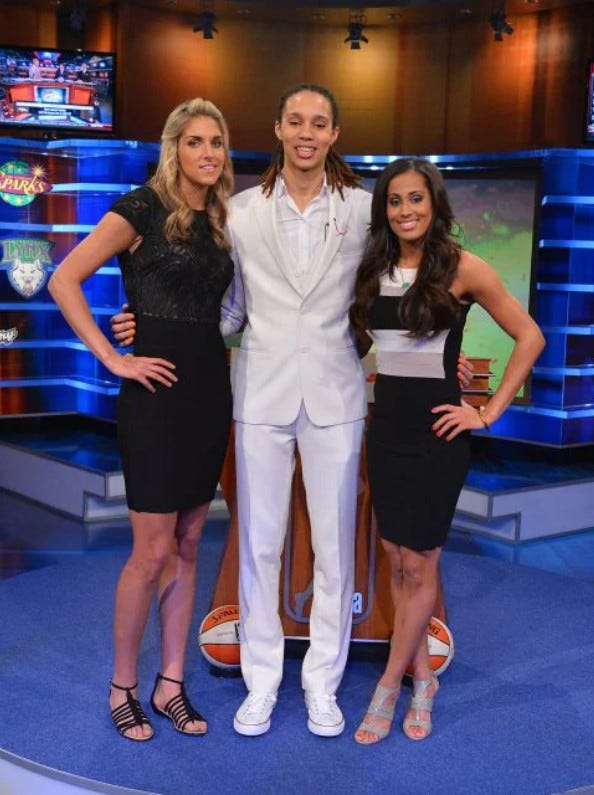
(PHOTO FROM MY FACEBOOK MEMORIES IN 2013)
The memory didn’t announce itself. It just appeared, like a time capsule.
A Facebook notification. A photo from 2013. Three players standing shoulder to shoulder, smiling like the future had not asked anything of them yet. Before the weight. Before the expectations. Before the league asked them to evolve into something more than promise.
Brittney Griner. Elena Delle Donne. Skylar Diggins.
Back when we called them “The Three to See,” a season-long marketing campaign initiated by ESPN during the 2012–13 women’s college basketball season to increase interest in the sport, promote individuals, and drive ratings.
We did not yet understand what we were seeing.
It was a fun time for sure, especially since I was at ESPN then, serving as the sports lead from the Stats & Analysis division for college basketball. The campaign was smart, savvy, and smooth. It turned all three players into household names, and ESPN made sure to spotlight the trio whenever possible throughout the season.
The WNBA heavily promoted the trio ahead of the 2013 season, introducing a new era of talent. But that visibility also created an uneasy dynamic when Griner, Delle Donne, and Diggins joined the league as rookies. College accolades mattered publicly but meant little in locker rooms shaped by veterans who built the WNBA and carried the edge of years of being overlooked.
I remember listening to a 2013 interview with an NPR station in which Diggins said, “I don’t ask for any of that. I think it’s disrespectful to say I’m one of the three to see in the WNBA because we’ve got so many great vets who have been here and done many things. I haven’t done anything yet.”
Looking back now, 13 years later, it is clear ESPN was ahead of its time with the “Three to See” campaign. As it turned out, each player created a lasting imprint on the WNBA and built a remarkable career. Delle Donne will be inducted into the Hall of Fame later this year. Griner is a WNBA champion and a transformational force. Diggins has been a perennial All-Star, and her journey back after having two children is proof of resilience.
That intentional approach of storytelling, coordinated visibility, and sustained narrative remains relevant today.
But it only worked because multiple factors were aligned. Timing. Interest. Infrastructure.
That is the standard now.
The WNBA has to think the same way. Storytelling cannot be fragmented. It must be coordinated. Draft entry should be positioned as part of a year-round narrative ecosystem across college basketball, broadcasters, sponsors, and digital media. The objective is not to extract stars from college prematurely, but to create an uninterrupted transition that retains narrative continuity for fans.
The “Three to See” campaign represented an early effort to build this type of narrative bridge between levels. The idea was sound, but at the time, the infrastructure to support it was not.
The college game could generate momentum, particularly in March, but the professional ecosystem lacked the capacity to sustain it. There was limited year-round coverage, minimal social media amplification compared to today, no NIL-driven visibility, and fewer commercial incentives aligned around individual player brands.
The result was a break in narrative continuity. Fans were asked to rediscover players they had just emotionally invested in.
Today, that gap has narrowed significantly.
A’ja Wilson helped close it.
When she entered the league in 2018, Wilson arrived as a national champion, the No. 1 pick, and a leader. What followed was not just success, but distinction. MVP performances. Championships. A presence the league could build around in real time.
She became proof that a star did not just have to arrive with momentum. The league could nurture it, amplify it, and sustain it.
Now, that process is accelerating.
Players like Caitlin Clark and Angel Reese entered the WNBA as public figures with national followings, strong identities, and ongoing storylines. The 2024 WNBA Draft and season ratings showed that audiences now invest in arrival and progression.
The takeaway is not that “Three To See” failed. It anticipated the moment. It simply arrived before the ecosystem could support it.
Now, for the first time, the WNBA has the structural support to match the moment. Media attention. Digital reach. NIL-driven visibility. Rising commercial investment. It can receive players while their stories remain active in the public consciousness. It also has a Collective Bargaining Agreement prepared to significantly increase compensation.
“Three To See” told audiences these players mattered.
Today, the audience already knows.
The responsibility now is not introduction. It is continuity.
Previously, the narrative began in college and restarted in the pros.
Now, the story is already in motion.
The question is whether the league can stay with it.