I Finally Reached My Breaking Point
After 25 years in journalism, I couldn't stay silent about what the Caitlin Clark conversation has become.

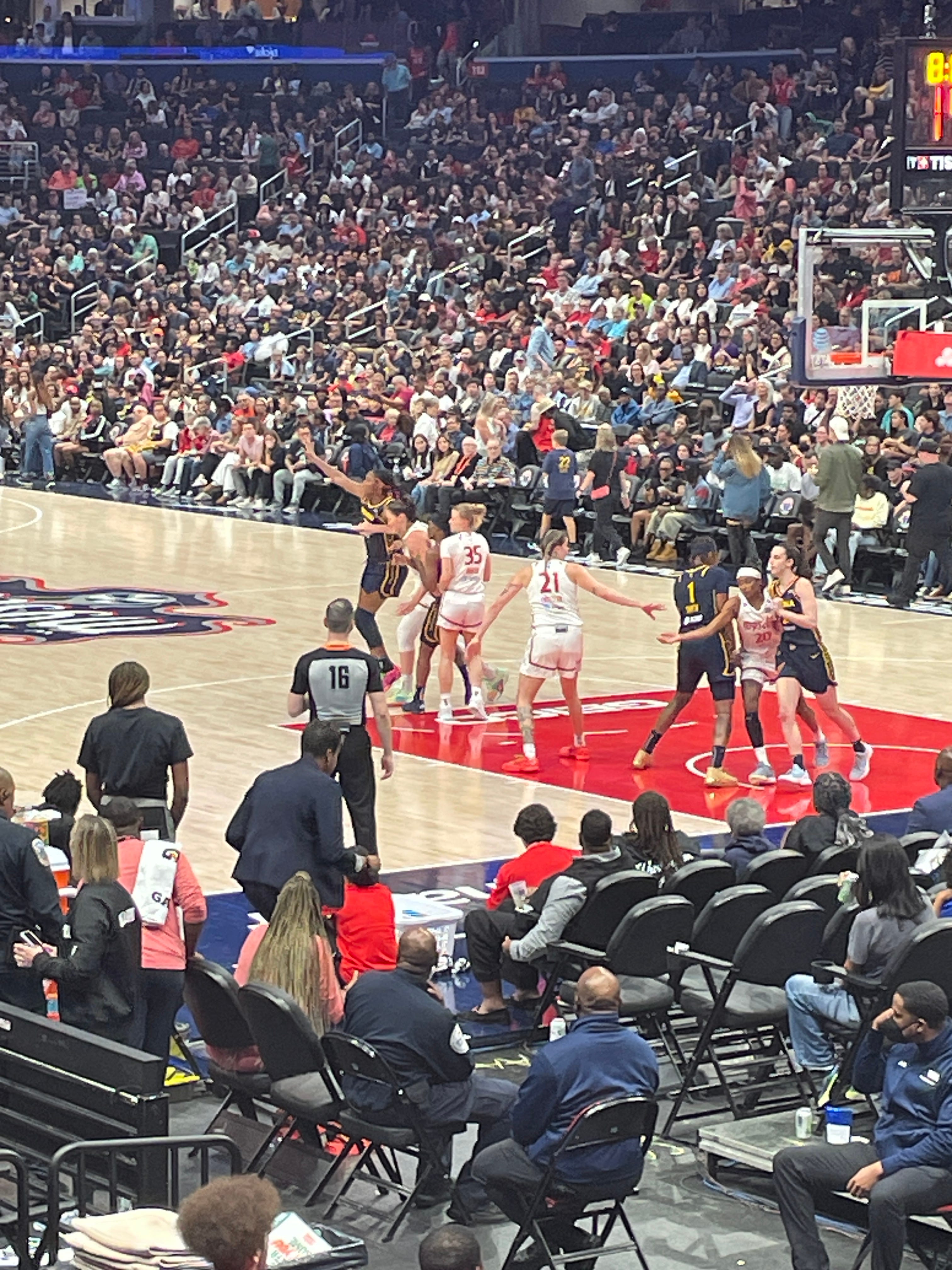
Photo from Mystics-Fever game in 2024 taken by me.
I finally reached my breaking point.
Not because of a hard foul. Not because of another debate over officiating. Not even because of the endless arguments about Caitlin Clark that have consumed social media for more than three exhausting years.
It was one post.
Someone compared Clark absorbing a forearm to the throat during a basketball game to George Floyd’s murder.
I stared at my phone in disbelief. For a moment, I wanted to throw it across the room. Instead, I did what I’ve done too many times lately: I shook my head and closed the app.
I’ve noticed a troubling pattern. Whenever something negative happens to Clark, a wave of people emerges from the darkest corners of the internet. They weaponize the moment to spread racism, demean Black women, attack the WNBA, and say things they would likely never utter face-to-face.
The basketball disappears. Humanity disappears. What’s left is outrage without boundaries.
I’m frustrated by it.
Engaging with it is draining. Ignoring it feels like surrender. Somewhere between those two choices is the uncomfortable realization that silence can begin to feel like complicity.
Two things can be true at the same time. Players deserve better protection from officials. The racist attacks directed at Black players are reprehensible. Those positions are not mutually exclusive.
Mind you, the WNBA is thriving in its 30th season, and officiating remains one of the most difficult and thankless jobs in sports. Most reasonable people acknowledged in real time that Clark absorbed a fist to the throat and that it should have been called. The league reviewed the play and upgraded it the following day.
That should have been the end of it.
Instead, social media turned into a forensic investigation, flooding timelines with years’ worth of clips showing missed calls involving other players, or sharing a collection of Clark’s greatest hits of opponents being physical with her, as if to prove that inconsistency somehow justified another missed call. Officiating has never been perfect. Anyone who has watched basketball long enough knows that.
Clark is one of the league’s brightest stars and someone every opponent must game-plan for. I don’t enjoy seeing her struggle, and I certainly don’t enjoy watching people celebrate when she does. But part of the reason every moment involving Clark becomes so combustible is that social media has elevated nearly everything she does into either validation of greatness or evidence of failure. There is rarely room for anything in between.
Then there’s the word “jealousy.”
For three years, that accusation has been thrown around as though it were a fact. Yet I can’t recall a single WNBA player publicly saying she was jealous of Caitlin Clark. It’s a narrative that has often been repeated far more than it has been reported. That’s why nuance matters. Repetition doesn’t create truth.
It’s discouraging how often moments involving Clark become an excuse for people to unleash rhetoric so toxic it makes my skin crawl. Meaningful basketball discussion quickly gives way to personal attacks, racial animosity, conspiracy theories, and culture-war talking points. Healthy disagreement has been replaced by performative outrage.
I know because I’ve experienced it firsthand.
Last year, I posted an interview I conducted with Angel Reese on my personal TikTok account. Less than two hours later, I deleted it. The comment section became so toxic that the interview itself was no longer the story. No journalist should have to remove an interview because the audience refuses to treat another human being with basic decency.
Social media makes that easy. A keyboard provides distance. Algorithms reward the loudest voices while accountability often disappears. Some of the most inflammatory posts come from anonymous accounts with little influence, yet they can reach millions because outrage travels faster than nuance.
The conversation doesn’t stop there. Television personalities and national commentators amplify the narrative by insisting Clark isn’t protected, that the league is failing her, or even that she should leave the WNBA. Those opinions are fair game. But too often they become fuel for an online audience already looking for reasons to attack players, question the league’s integrity, or inflame racial tensions rather than discuss basketball.
Here’s a sobering dose of reality. Like this world itself, it will continue with or without us. The WNBA existed before Clark and will exist after she retires.
Too often, media outlets reward outrage because outrage performs. Anonymous posts become television segments. Manufactured controversy becomes content. The result isn’t better journalism. It’s a louder echo chamber where fans don’t trust the media, which is unfortunate.
Debate officiating. Debate physical play. Debate coaching decisions. That’s sports. But reducing athletes to racial stereotypes or using them as props in a culture war isn’t analysis.
It’s exploitation.
This isn’t easy, and I’m not pretending I’m above it. I’ve quote-tweeted posts out of frustration. I’ve given attention to opinions that probably deserved none. We all have to become more disciplined about what we amplify because every repost gives toxic content a larger audience.
Just this week, I saw someone claim that Clark hadn’t been injured on Saturday—that she had simply quit on her team. There was no reporting to support it. No evidence. No confirmation. Just an accusation disguised as fact. Predictably, it spread anyway.
The saddest part is that the conversation has once again become bigger than the game. That’s a shame because the basketball has never been better.
Instead of celebrating the extraordinary basketball happening across the WNBA, we’re trapped in another cycle of outrage. Seattle’s Flau’jae Johnson continues to shine. Marina Mabrey tied a league single-game scoring record with 53 points. Kelsey Mitchell remains one of the WNBA’s elite scorers. Paige Bueckers has been sensational in her second year. A’ja Wilson continues to author one of the great careers in league history.
The WNBA is experiencing one of the most exciting periods in its 30-year history. It deserves to be known for the excellence on the court, not the outrage surrounding it.
Unfortunately, that’s the social media economy we’ve created. Facts move at a walking pace. Outrage travels at the speed of light.
That’s also why simply logging off isn’t enough. Ignoring it doesn’t make it disappear. Sometimes the only responsible response is to add a voice grounded in context, evidence, and experience. After more than 25 years in journalism, I felt a responsibility to share mine.
When outrage becomes more valuable than truth, everybody loses: the players, the league, the fans, and journalism itself.
Great story!